
The Divyang Shadi Protsahan Yojana 2026 is commonly searched as a government financial assistance programme for marriages involving persons with disabilities. However, applicants must understand one important fact before submitting an application: India does not have one uniform Central scheme operating under this exact name with the same grant, eligibility rules and application portal in every state.
Instead, several state governments operate their own Divyang Marriage Scheme, Disabled Marriage Incentive Scheme, Divyang Vivah Protsahan Yojana or marriage-assistance programme. The grant may range from a modest one-time incentive to several lakh rupees, depending on the applicant’s state, disability percentage, type of marriage and applicable government order.
For example, Uttar Pradesh, Haryana, Gujarat, Maharashtra, Madhya Pradesh and Uttarakhand have published official information relating to marriage incentives involving persons with disabilities. Other states may assist with broader social welfare, marriage assistance, construction-worker or disability welfare schemes.
In this detailed guide, we explain the verified benefits, general eligibility conditions, required documents, application procedure, verification process, and important state-wise differences applicable in 2026.
Important: Applicants should never rely only on an unofficial article, social-media post or YouTube video. The final benefit will depend on the latest notification issued by the respective State Social Welfare Department, Divyangjan Empowerment Department or competent district authority.
What Is Divyang Shadi Protsahan Yojana 2026?
The Divyang Shadi Protsahan Yojana 2026 refers to state government programmes that provide a one-time financial incentive when:
- A person with a disability marries a non-disabled person;
- Two persons with disabilities marry each other;
- A person marries an eligible person with a specified disability;
- A couple fulfils additional state-specific income, residency and marriage-registration conditions.
The purpose of such a Government Scheme for Disabled Marriage is not simply to pay wedding expenses. These programmes are generally designed to support social inclusion, rehabilitation, financial stability and independent married life for persons with disabilities.
The exact name of the scheme may differ. Common names include:
- Divyang Marriage Incentive Scheme
- Divyang Vivah Protsahan Yojana
- Divyangjan Marriage Promotion Scheme
- Marriage Incentive Reward Scheme
- Divyang Lagna Sahay Yojana
- Nishaktjan Vivah Protsahan Yojana
- Disabled Marriage Incentive Scheme
- Marriage Assistance Scheme for Persons with Disabilities
Applicants must search for the official scheme name used in their state rather than assuming that every portal will display the term Divyang Shadi Protsahan Yojana.
Divyang Shadi Protsahan Yojana 2026 Highlights
| Particular | Details |
|---|---|
| Scheme Name | Divyang Shadi Protsahan Yojana, Divyang Vivah Protsahan Yojana or equivalent state scheme |
| Year | 2026 |
| Administrative Authority | State Social Welfare Department, Divyangjan Empowerment Department or Social Justice Department |
| Beneficiaries | Eligible married couples where one or both spouses have a recognised disability |
| Financial Assistance | Varies by state and type of marriage |
| Minimum Disability | Commonly 40%, but state rules must be checked |
| Application Mode | Online, offline or both, depending on the state |
| Payment Mode | Usually Direct Benefit Transfer into an eligible bank account |
| Official Website | uphwd.gov.in/state-government-schemes |
| Scheme Status | Available in selected states under different names and rules |
| Central Scheme Status | No uniform nationwide marriage incentive under this exact name was identified |
| Article Last Verified | 21 July 2026 |
Uttar Pradesh’s official department describes a marriage incentive programme operating since 1997, while Gujarat, Madhya Pradesh, Haryana, Maharashtra and Uttarakhand publish separate state provisions. This confirms that the benefit is state-administered rather than nationally standardised.
Objectives of the Divyang Marriage Scheme
The principal objectives of a Disability Marriage Scheme generally include the following:
1. Promoting social inclusion
The scheme encourages equal participation of persons with disabilities in family and community life.
2. Supporting newly married couples
A one-time grant can help couples manage essential household expenses, accommodation, assistive equipment, transportation or self-employment needs.
3. Reducing social discrimination
Marriage incentive programmes may encourage society to overcome negative attitudes surrounding disability and marriage.
4. Strengthening financial independence
Some couples use the grant to purchase household items, begin a small business or create an emergency fund.
5. Encouraging legal marriage registration
Most state schemes require a valid marriage registration certificate. This improves legal protection for both spouses.
6. Supporting rehabilitation
Several government schemes connect the incentive with the wider social rehabilitation and empowerment of persons with disabilities.
Key Benefits of Divyang Shadi Protsahan Yojana 2026
Depending on the state, eligible couples may receive:
- A one-time marriage incentive;
- Direct payment into an individual or joint bank account;
- A larger benefit when both spouses have disabilities;
- Support for a marriage between a person with and without a disability;
- Fixed-deposit protection for part of the assistance;
- Access to other state disability welfare services;
- District-level assistance with verification and documentation;
- Financial support without repayment.
This assistance is generally a grant and not a loan. However, the sanctioning authority may recover the amount if the applicant obtained it through false documents, duplicate claims, or deliberate misrepresentation.
Financial Assistance Under Divyang Shadi Protsahan Yojana 2026
There is no single national Divyang Marriage Financial Assistance amount. Each state decides its own grant, qualifying conditions, payment structure, and budget allocation.
Verified State-Wise Financial Assistance Comparison
| State | Marriage Category | Officially Published Assistance |
|---|---|---|
| Uttar Pradesh | Disabled groom and non-disabled bride | ₹15,000 |
| Uttar Pradesh | Disabled bride and non-disabled groom | ₹20,000 |
| Uttar Pradesh | Both spouses disabled | ₹35,000 |
| Haryana | One spouse disabled | ₹31,000 |
| Haryana | Both spouses disabled | ₹51,000 |
| Gujarat | One disabled spouse marrying a non-disabled spouse | ₹75,000 |
| Gujarat | Both spouses disabled | ₹1,50,000 in total |
| Maharashtra | Disabled and non-disabled marriage | ₹1,50,000 |
| Maharashtra | Both spouses disabled | ₹2,50,000 |
| Madhya Pradesh | Disabled person marrying a non-disabled person | ₹2,00,000 |
| Madhya Pradesh | Both spouses disabled | ₹1,00,000 jointly |
| Uttarakhand | Marriage involving an eligible disabled bride or groom | ₹25,000 under the published government order |
| Rajasthan | Specially-abled couple under older official Sukhad Dampatya material | ₹50,000; current sanction must be reconfirmed |
| Bihar | Mukhyamantri Divyangjan Vivah Protsahan Anudan Yojana | Current amount should be confirmed from the department before publication or application |
Uttar Pradesh assistance
The Uttar Pradesh Divyangjan Empowerment Department publishes an incentive of ₹15,000 when the groom is disabled, ₹20,000 when the bride is disabled and ₹35,000 when both spouses are disabled. The same official page states that the programme has operated since 1997.
Haryana assistance
Haryana includes Divyangjan beneficiaries under the Mukhya Mantri Vivah Shagun Yojna. The official scheme page lists ₹51,000 where both newly married spouses are disabled and ₹31,000 where one spouse is disabled.
Gujarat assistance
Gujarat’s Director of Social Defence states that a disabled person marrying a non-disabled person may receive ₹75,000. If both spouses are disabled, each side is eligible for ₹75,000, making the total assistance ₹1,50,000 per couple.
Maharashtra assistance
Maharashtra’s Divyang Sahayak portal publishes ₹1,50,000 for a disabled–non-disabled marriage and ₹2,50,000 for a disabled–disabled marriage. It also states that 50% of the assistance is placed in a fixed deposit for five years.
Madhya Pradesh assistance
The Madhya Pradesh Social Justice and Disabled Persons Welfare Department publishes ₹2 lakh when an eligible disabled person marries a non-disabled person and ₹1 lakh jointly when both spouses are disabled.
Uttarakhand assistance
The Uttarakhand Social Welfare Department’s current document section lists a government order providing an incentive grant of ₹25,000 for marriage involving a disabled young man or woman. The order is dated 10 November 2014, so applicants should verify whether any later district-level instruction has modified the amount or procedure.
Rajasthan assistance
Rajasthan’s official historical policy material refers to ₹50,000 under the Sukhad Dampatya Yojana for a specially-abled couple. The Rajasthan 2025–26 budget-at-a-glance document also included a target to provide marriage assistance to 200 specially-abled persons. However, a clearly updated 2026 public guideline specifying the current amount was not identified in the official pages reviewed. Applicants should therefore confirm the present benefit through the Directorate of Specially Abled Persons or an e-Mitra centre.
Divyang Marriage Eligibility Criteria
Eligibility differs substantially by state. The following conditions are commonly applied, but applicants must read the notification applicable to their domicile state.
1. Citizenship
The applicant and spouse are normally required to be Indian citizens.
Some schemes require both spouses to be Indian citizens, while others focus primarily on the citizenship and domicile of the disabled applicant.
2. State residency
At least one spouse, and sometimes both spouses, must be a permanent resident of the state providing the benefit.
For example, Uttar Pradesh requires the couple to be Indian citizens and the eligible person to be a permanent resident of Uttar Pradesh or to have lived there for the prescribed period.
3. Valid disability certificate
The applicant must generally possess:
- A disability certificate issued by an authorised government medical board; or
- A valid Unique Disability ID card, where accepted.
A private doctor’s prescription alone normally does not establish scheme eligibility.
4. Minimum disability percentage
A minimum disability of 40% is common in several state schemes.
Uttar Pradesh, Maharashtra and Madhya Pradesh expressly refer to a minimum disability level of 40% in their published scheme information.
However, applicants should not assume that 40% automatically qualifies them in every state. A notification may restrict the benefit to particular disability categories or impose a higher benchmark.
5. Age requirement
The age requirement generally follows the scheme notification and legally recognised marriage age.
Commonly published conditions include:
- Bride: at least 18 years;
- Groom: at least 21 years;
- Maximum age: applicable in certain states.
Uttar Pradesh’s published rules place the eligible age range at 18–45 for the woman and 21–45 for the man.
6. Income criteria
Income rules are not uniform.
A state may require that:
- Neither spouse is an income-tax payer;
- Annual family income remains below a specified limit;
- The couple belongs to a particular income category;
- No income ceiling applies.
Maharashtra’s current scheme page states that there is no annual income limit, whereas Uttar Pradesh and Madhya Pradesh exclude income-tax payers under their published provisions.
7. Registered marriage
A valid marriage registration certificate is one of the most important documents.
A wedding invitation, temple receipt, photographs or affidavit may support the application, but they may not replace legal registration where the scheme specifically requires a registered marriage.
8. First-marriage condition
Some states restrict the benefit to a first marriage or require the applicant to confirm that neither spouse has a living husband or wife.
Where a previous marriage ended through divorce or the death of a spouse, the applicant may need to provide a court decree or death certificate.
9. Criminal-case conditions
Certain schemes may disqualify applicants convicted of specified criminal offences or involved in proceedings concerning cruelty or harassment.
Uttar Pradesh’s published conditions state that neither spouse should have been convicted in a criminal case and refer to additional restrictions involving a living spouse and proceedings relating to harassment.
10. Application deadline
Many schemes require the application to be submitted within a fixed period after marriage.
Examples include:
- Maharashtra: within one year of marriage;
- Madhya Pradesh: within one year;
- Chhattisgarh: official 2026 information refers to an application within six months;
- Other states may prescribe 30 days, six months or one year.
Missing the deadline can make an otherwise eligible couple ineligible.
11. No duplicate government benefit
Some schemes prohibit a couple from receiving two incentives for the same marriage. Applicants must disclose any marriage grant received from another department.
Documents Required for Divyang Marriage Scheme
The following Divyang Marriage Documents are commonly requested.
| Document | Purpose |
|---|---|
| Aadhaar cards of both spouses | Identity verification |
| Disability certificate | Establishes disability category and percentage |
| UDID card | Standardised disability identification, where required |
| Marriage registration certificate | Confirms legally registered marriage |
| Domicile or residence certificate | Establishes state eligibility |
| Age proof of both spouses | Confirms minimum and maximum age |
| Recent photographs | Applicant and couple identification |
| Joint marriage photograph | Supports proof of marriage |
| Bank passbook | Enables DBT payment |
| Aadhaar-bank seeding proof | Prevents payment failure |
| Joint bank account details | Required in certain states |
| Income certificate | Confirms income eligibility |
| Non-income-tax-payer declaration | Required under certain schemes |
| Wedding invitation card | Supporting evidence |
| Affidavit regarding first marriage | Prevents duplicate or ineligible claims |
| Divorce decree | Required when a previous marriage ended legally |
| Death certificate of former spouse | Required in applicable remarriage cases |
| Mobile number | OTP and application communication |
| Self-declaration form | Confirms accuracy of submitted information |
Maharashtra specifically lists the marriage registration certificate, Aadhaar-linked joint bank passbook, domicile certificate, disability certificate or UDID and Aadhaar card on its official portal.
Document tip: The name, date of birth and spelling on Aadhaar, disability certificate, bank account and marriage certificate should match. Even a small mismatch can delay verification.
How to Apply Online for Divyang Shadi Protsahan Yojana
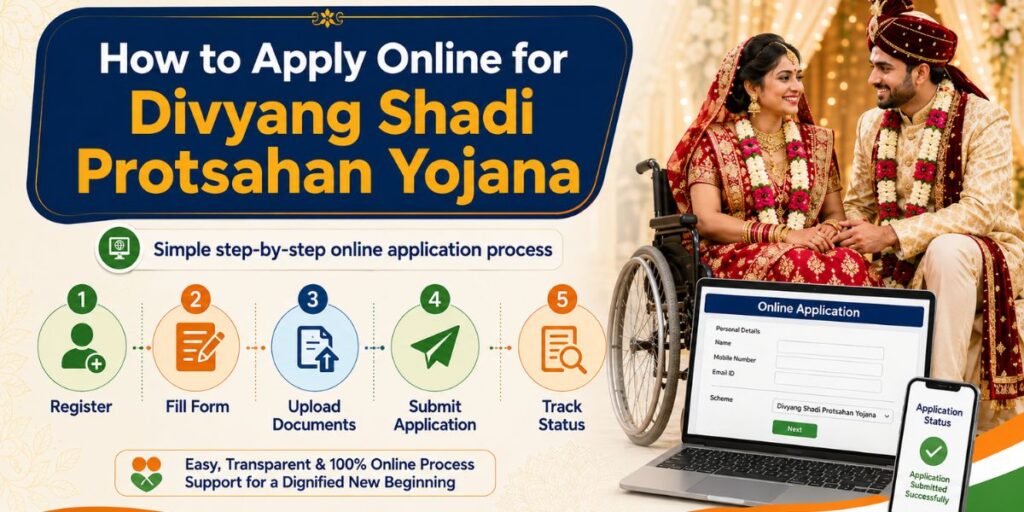
There is no single Divyang Marriage Online Apply link for all India. Applicants must use the portal designated by their state government.
Step 1: Identify the correct state scheme
Search the official website of the:
- Social Welfare Department;
- Social Justice Department;
- Department of Empowerment of Persons with Disabilities;
- Divyangjan Empowerment Department;
- State e-District or ServicePlus portal;
- myScheme portal.
Do not begin an application through a private website asking for registration fees.
Step 2: Read the latest scheme notification
Check:
- Eligible disability categories;
- Minimum disability percentage;
- Income limit;
- Age limit;
- Grant amount;
- Application deadline;
- Required bank account type;
- Whether the marriage must be registered before applying.
Step 3: Register on the official portal
Create an applicant account using:
- Mobile number;
- Aadhaar or approved identification;
- Email address, where required;
- State resident details.
Complete OTP verification.
Step 4: Select the marriage incentive service
Choose the correct service name, such as:
- Marriage Incentive Reward Scheme;
- Divyang Vivah Protsahan Yojana;
- Divyang Lagna Sahay Yojana;
- Nishaktjan Vivah Protsahan Yojana;
- Marriage Assistance for Persons with Disabilities.
Step 5: Enter applicant and spouse details
Provide:
- Full names;
- Dates of birth;
- Residential addresses;
- Disability percentage;
- Disability certificate number;
- Marriage date;
- Marriage registration number;
- Bank details;
- Income information.
Step 6: Upload documents
Upload clear scans in the permitted format and file size.
Avoid blurred photographs, cropped certificates or password-protected PDF files.
Step 7: Review the application
Check all spellings, certificate numbers, dates and bank details before submission.
Step 8: Submit and save acknowledgement
After submission, download or print:
- Application number;
- Acknowledgement receipt;
- Submitted application copy.
The acknowledgement is required for status tracking and grievance submission.
Step 9: Respond to objections
The district office may request:
- A corrected document;
- Physical verification;
- Original certificates;
- Clarification regarding residency, income or marriage registration.
Respond before the specified deadline.
Example: Uttar Pradesh
Uttar Pradesh’s official page directs eligible applicants to the state Divyangjan portal. It states that the District Divyangjan Empowerment Officer verifies the application and the District Magistrate provides approval.
Offline Application Process
Where online submission is unavailable or difficult, applicants may follow the offline process.
- Visit the District Social Welfare Office, District Divyangjan Empowerment Office, municipal office, block office or other authority named in the notification.
- Request the latest application form.
- Read the instructions carefully.
- Complete all mandatory fields.
- Attach self-attested copies of the required documents.
- Carry original documents for verification.
- Submit the form to the receiving officer.
- Obtain a signed and stamped receipt.
- Keep a photocopy of the complete application.
- Follow up using the diary number or application reference.
Madhya Pradesh permits applications in the prescribed format through the office of the Joint Director or Deputy Director of Social Justice and Disabled Welfare, Janpad Panchayat or urban local body, according to its published procedure.
Selection Process
The Divyang Marriage Grant is generally not awarded through a lottery. Selection usually depends on documentary eligibility and budget availability.
The department may examine:
- Applicant identity;
- State domicile;
- Disability certificate validity;
- Disability percentage;
- Age of both spouses;
- Marriage registration;
- Date of marriage;
- Income eligibility;
- Bank account status;
- Previous marriage or duplicate benefit records;
- Authenticity of uploaded documents;
- Availability of funds.
An applicant becomes eligible only after the designated authority sanctions the case. Merely submitting an application does not create an automatic right to payment.
Verification Process
Verification may take place at several levels.
Document verification
Officials check whether the certificates are complete, readable, valid and issued by competent authorities.
Disability verification
The disability certificate number, percentage and issuing medical authority may be confirmed.
Residence verification
The department may verify domicile through government databases, local authorities or physical inspection.
Marriage verification
Officials may check the registration certificate with the marriage registrar.
Bank verification
The applicant’s name, account number, IFSC code and Aadhaar mapping may be validated.
Field verification
In selected cases, a welfare officer, local body employee or district official may contact the couple or visit the declared address.
Payment Process
After final approval, assistance is generally released through Direct Benefit Transfer.
Depending on the scheme, payment may be made to:
- The disabled applicant’s bank account;
- A joint account of both spouses;
- An Aadhaar-linked account;
- A combination of immediate payment and fixed deposit.
Maharashtra requires an Aadhaar-linked joint bank account and places half of the sanctioned assistance in a five-year fixed deposit.
Chhattisgarh’s official 2026 report also describes payment through DBT into a joint account in an approved case.
Payment can fail when:
- The account is inactive;
- The name does not match Aadhaar;
- The IFSC code is incorrect;
- Aadhaar is not seeded;
- The account cannot receive DBT;
- The bank has imposed KYC restrictions.
How to Check Divyang Marriage Application Status
Applicants may check the status through one of the following methods:
- Log in to the state application portal.
- Open Track Application, Application Status or View Submitted Applications.
- Enter the application or reference number.
- Complete OTP or captcha verification.
- Review the current stage.
Possible status messages include:
- Application submitted;
- Pending for document verification;
- Pending at district level;
- Objection raised;
- Returned for correction;
- Recommended;
- Approved;
- Sanction order generated;
- Payment initiated;
- Payment completed;
- Rejected.
For an offline application, contact the receiving office with the acknowledgement or diary number.
State-Wise Divyang Marriage Schemes in 2026
Uttar Pradesh
Uttar Pradesh operates a Marriage Incentive Reward Scheme through the Divyangjan Empowerment Department.
Published benefits are:
- ₹15,000 when the groom is disabled;
- ₹20,000 when the bride is disabled;
- ₹35,000 when both spouses are disabled.
The official conditions include at least 40% disability, state residence, registered marriage, specified age limits, non-income-tax-payer status and other legal conditions.
Rajasthan
Rajasthan has referred to marriage support for specially-abled persons through the Sukhad Dampatya Yojana and related welfare provisions.
Older official material refers to ₹50,000, while the 2025–26 state budget document included a target for marriage assistance to 200 specially-abled persons. Because a clearly revised 2026 operational guideline was not available on the reviewed public pages, applicants should confirm the current amount and eligibility through the Directorate of Specially Abled Persons or e-Mitra.
Haryana
Haryana includes Divyangjan couples under the Mukhya Mantri Vivah Shagun Yojna.
The official benefit table provides:
- ₹51,000 where both spouses are disabled;
- ₹31,000 where one spouse is disabled.
Applicants should check the current family-income, registration and application-timeline requirements before submission.
Delhi
The current Delhi disability-scheme pages reviewed prominently list disability pension and other welfare assistance. A dedicated general marriage incentive for a disabled bride, groom or couple was not identified in the current public service list.
Delhi residents should contact the District Social Welfare Office before assuming that a Divyang Marriage Incentive is available. Disability pension or worker-specific marriage benefits should not be confused with a disability marriage incentive.
Punjab
A dedicated general Divyang Marriage Scheme was not identified in the Punjab public scheme pages reviewed. Punjab does have separate marriage assistance for categories such as registered construction workers and eligible defence families, but these programmes are not equivalent to a universal disability marriage incentive.
Applicants should verify the current position with the Department of Social Security, Women and Child Development or a Punjab Sewa Kendra.
Gujarat
Gujarat operates the Divyang Lagna Sahay Yojana.
Official assistance is:
- ₹75,000 when a disabled person marries a non-disabled person;
- ₹1,50,000 in total when two disabled persons marry.
Applicants should use the official Social Justice and Empowerment or e-Samaj Kalyan system and confirm the required disability categories and documents.
Maharashtra
Maharashtra’s marriage incentive covers:
- Disabled–non-disabled marriages: ₹1,50,000;
- Disabled–disabled marriages: ₹2,50,000.
The applicant must generally have at least 40% disability, satisfy the age requirement, submit the application within one year of marriage and maintain an Aadhaar-linked joint account. Fifty per cent of the grant is retained in a five-year fixed deposit.
Madhya Pradesh
Madhya Pradesh operates the Divyang Vivah Protsahan Yojana, introduced through an order dated 12 August 2008.
The official scheme page publishes:
- ₹2 lakh for an eligible disabled person marrying a non-disabled person;
- ₹1 lakh jointly where both spouses are disabled.
The applicant must generally have at least 40% disability, be a Madhya Pradesh resident, meet the minimum age requirement, have a legally valid marriage and not be an income-tax payer.
Bihar
Bihar officially lists the Mukhyamantri Divyangjan Vivah Protsahan Anudan Yojana. Government records also refer to the scheme as part of the state’s disability welfare programmes.
However, the current assistance amount and complete 2026 conditions were not clearly displayed in the accessible official pages reviewed. Applicants should verify the benefit through Bihar’s Social Welfare Department, Directorate of Empowerment of Persons with Disabilities or ServicePlus portal rather than relying on an unofficial figure.
Uttarakhand
Uttarakhand’s official Social Welfare Department document page includes rules relating to marriage with a disabled person and a government order providing ₹25,000 as an incentive grant.
Since the publicly listed monetary order dates from 2014, applicants should verify whether the amount, income conditions or application method have subsequently changed.
Common Reasons for Application Rejection
An application may be rejected for any of the following reasons:
- Disability is below the prescribed percentage;
- Disability certificate is invalid or expired;
- Applicant is not a resident of the concerned state;
- Marriage is not legally registered;
- Application was submitted after the deadline;
- Bride or groom does not meet the prescribed age;
- Income exceeds the permitted limit;
- Applicant or spouse is an income-tax payer where prohibited;
- Names differ across Aadhaar, bank and certificates;
- Incorrect bank account or IFSC details were entered;
- Required affidavit was not attached;
- Applicant has already received another benefit for the same marriage;
- Previous marriage information was concealed;
- Uploaded documents are blurred or incomplete;
- False information was provided;
- Applicant did not respond to an objection notice;
- Bank account is inactive or not Aadhaar-linked;
- Marriage date is outside the eligible period;
- Application was filed under the wrong scheme or district.
Latest Divyang Marriage Scheme Updates for 2026
Maharashtra’s updated marriage incentive system
Maharashtra’s current Divyang Sahayak portal states that a government decision for the social-security marriage incentive scheme was issued on 18 December 2025. The portal publishes assistance of ₹1.5 lakh and ₹2.5 lakh, depending on the type of marriage, and was showing an update date of 21 July 2026 when reviewed.
Chhattisgarh’s 2026 implementation update
Although Chhattisgarh was not among the ten states listed above, it provides an important officially verified 2026 example. A state government release dated 31 January 2026 confirmed assistance of ₹50,000 where one spouse is disabled and ₹1 lakh where both are disabled. It also reported that more than 631 beneficiaries had received assistance up to financial year 2025–26.
No uniform Central grant announced
The official information reviewed continues to show state-specific programmes rather than one uniform national Disabled Marriage Scheme India with a common grant, application portal and eligibility standard.
Readers should treat websites claiming that every eligible couple in India automatically receives the same amount as unreliable unless they cite a current state government notification.
Advantages of the Scheme
- Provides immediate financial support;
- Encourages legal marriage registration;
- Supports independent household formation;
- Promotes social inclusion;
- Reduces some financial pressure after marriage;
- Encourages awareness of disability rights;
- Can support self-employment or essential purchases;
- Uses DBT to improve payment transparency;
- Provides larger support in certain states when both spouses are disabled.
Challenges and Limitations
Different rules in every state
Applicants cannot use one article or form for all states.
Outdated public pages
Some official portals continue to display old government orders even when the scheme remains listed.
Limited awareness
Many eligible couples do not learn about the scheme until the application deadline has passed.
Marriage-registration delays
Applicants may lose valuable time if they postpone legal registration.
Document mismatches
Different spellings or dates across certificates can delay approval.
Budget dependence
An eligible application may remain pending when funds have not yet been released.
Digital accessibility
Some applicants may face difficulty using online portals, scanning documents or completing OTP verification.
Unclear grievance procedure
Not every state displays a simple appeal or correction process.
Tips Before Applying
- Register the marriage as soon as possible.
- Check the application deadline before collecting documents.
- Use only an official government portal.
- Verify the latest grant amount from the notification.
- Ensure the disability certificate clearly shows the percentage.
- Apply for a UDID card where required.
- Match names across all documents.
- Keep the bank account active and KYC-compliant.
- Save scanned copies of every document.
- Download the submitted application.
- Keep the acknowledgement number secure.
- Check the status regularly.
- Respond immediately to an objection.
- Keep original documents available for physical verification.
- Do not pay an agent who promises guaranteed approval.
Common Mistakes to Avoid
- Applying through an unofficial website;
- Selecting the wrong state or district;
- Entering the wedding date instead of the registration date incorrectly;
- Uploading only wedding photographs without a registration certificate;
- Using another person’s bank account;
- Hiding a previous marriage;
- Submitting an expired disability certificate;
- Assuming that every state provides the same amount;
- Missing the post-marriage application deadline;
- Filing duplicate applications;
- Ignoring SMS or portal objections;
- Providing incorrect disability percentage;
- Uploading unreadable files;
- Sharing OTPs with unknown agents;
- Paying an unofficial application charge.
Conclusion
The Divyang Shadi Protsahan Yojana 2026 can provide meaningful financial support to eligible newly married couples, but it should not be presented as one identical all-India programme.
The scheme name, Divyang Marriage Eligibility, disability percentage, income requirement, grant amount, bank-account condition and application deadline can change from one state to another. Uttar Pradesh, Haryana, Gujarat, Maharashtra, Madhya Pradesh and Uttarakhand publish different assistance structures, while the position in states such as Delhi, Punjab, Bihar and Rajasthan requires careful verification through the relevant department.
Before applying, we recommend checking the latest government order, completing Divyang Marriage Registration, preparing matching documents and submitting the form within the prescribed period.
Applicants should always verify the latest notification on the official state government portal, myScheme platform or the respective State Social Welfare Department website before relying on any amount or procedure.
Frequently Asked Questions
1. What is Divyang Shadi Protsahan Yojana 2026?
It is a commonly used name for state government schemes that provide a marriage incentive to eligible couples where one or both spouses have a disability.
2. Is it a Central Government scheme?
No uniform Central marriage incentive operating under this exact name with one nationwide benefit and application form was identified. The schemes are primarily state-specific.
3. How much money is provided?
The amount differs by state. Verified examples range from ₹15,000 in one Uttar Pradesh category to ₹2.5 lakh for an eligible disabled–disabled marriage in Maharashtra.
4. Can both disabled spouses receive assistance?
Yes, several states provide assistance when both spouses are disabled. The amount and payment structure depend on the state.
5. Can a disabled person marrying a non-disabled person apply?
Yes, states such as Gujarat, Maharashtra and Madhya Pradesh expressly provide benefits for eligible disabled–non-disabled marriages.
6. What is the minimum disability percentage?
Many states require at least 40% disability. Applicants must verify the exact threshold and eligible disability categories from their state notification.
7. Is a UDID card compulsory?
It depends on the state. Some departments accept a valid disability certificate, while others may request a UDID card or prefer it for digital verification.
8. Is marriage registration compulsory?
It is compulsory under several state schemes and should be completed before applying unless the notification expressly provides otherwise.
9. Can an unregistered religious marriage qualify?
A religious ceremony may establish that a marriage took place, but it may not satisfy a scheme that specifically requires a government-issued marriage registration certificate.
10. What is the age limit?
Common minimum ages are 18 years for the bride and 21 years for the groom. Some states also prescribe a maximum age, such as 45 years.
11. Is there an income limit?
The rule varies. Maharashtra’s current portal shows no income limit, while other schemes may exclude income-tax payers or impose a family-income ceiling.
12. Can income-tax payers apply?
They may be ineligible in states whose scheme rules expressly exclude income-tax payers, including the published provisions of Uttar Pradesh and Madhya Pradesh.
13. Is the scheme available for a second marriage?
Some states restrict the benefit to the first marriage or require proof that neither spouse has another living spouse. Divorced or widowed applicants must review the specific rules.
14. When should the application be submitted?
The deadline varies. Some states allow one year, while others may require submission within six months or another specified period after marriage.
15. Can we apply before the wedding?
Usually, marriage incentive schemes require the marriage to have taken place and been registered. Applicants should check their state notification for any exception.
16. How is the money paid?
Payment is generally made through DBT into the approved bank account. Certain schemes require a joint account.
17. Why is a joint account required?
A joint account confirms the couple’s banking relationship and allows the department to transfer or secure the benefit for both spouses.
18. How long does approval take?
No single nationwide processing period applies. Processing depends on document verification, district approval, objection clearance and fund availability.
19. Can an application be corrected after submission?
Many portals allow correction only when the department returns the application or raises an objection. Applicants should review every field before final submission.
20. What should we do if the application is rejected?
Read the rejection reason, obtain a written order where possible and contact the district welfare authority. If an appeal or grievance mechanism is available, submit the correction with supporting documents.
21. Can a couple receive two marriage grants?
Usually, duplicate assistance for the same marriage is restricted. Applicants must disclose any benefit received from another government department.
22. Is there an application fee?
Government welfare applications are usually free or may involve only a notified service charge at a CSC or facilitation centre. Applicants should not pay an unauthorised agent.
23. Are all disability categories eligible?
Not necessarily. Eligibility may depend on the recognised disability category, disability percentage and state rules.
24. Can we apply from a state where we work but are not permanent residents?
Usually, the benefit is linked to domicile or prescribed residence. Employment in a state alone may not establish eligibility.
25. Where can we obtain the application form?
The form may be available on the state welfare portal, e-District portal, ServicePlus portal, district welfare office, municipal body, Janpad Panchayat, CSC or e-Mitra centre.
26. What happens if the bank payment fails?
Contact the sanctioning office and bank. Correct the account number, IFSC, KYC or Aadhaar-seeding issue and submit the required bank proof.
27. Can an applicant apply without Aadhaar?
This depends on the notification and applicable identification rules. Most current digital applications request Aadhaar, but an official alternative may exist in specific circumstances.
28. Is the grant taxable?
Tax treatment depends on the nature of the payment and applicable tax law. Beneficiaries with a specific tax concern should obtain advice from a qualified tax professional.